Instant Digital Download

30-Day Money-Back Guarantee

Works From Any Office Chair

Desk Reset Protocol

Promotes "Interrupt The Desk Compression Cycle"

For Desk Workers Who Want to End the Day Without Back Pain

Use This 3-Session Reset System to Decompress Your Spine in Just 9 Minutes a Day Without New Equipment, a Gym, or Leaving Your Chair

Three 3-minute chair-based resets, timed to the exact windows where daily compression builds and locks in. Get through a full workday and feel fine by five. Results in 14 days.

One-time payment · No subscription · Instant download

65%

of desk workers develop
musculoskeletal issues

3 min

per reset session
no mat, no equipment

14

days to measurably
lower back tension

21%

pain recurrence vs 44%
in control groups

You know the feeling. It starts around midday. A dull pressure in the lower back, a tightness that was not there at nine. By three o'clock you are shifting in your seat. By five, you are carrying it home with you.

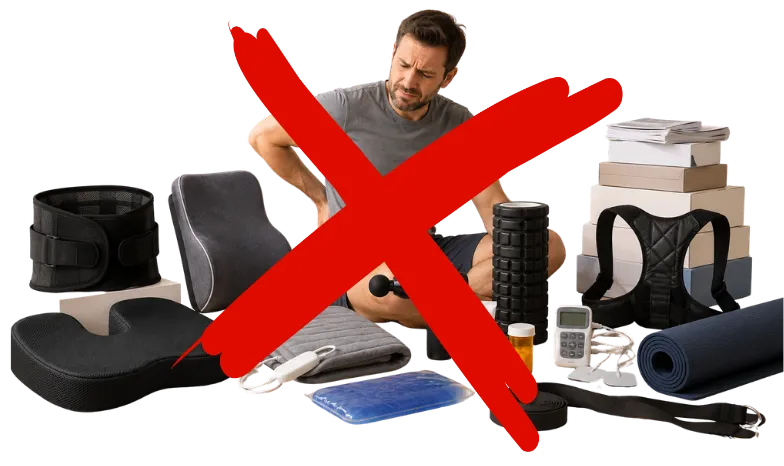
You have probably tried things. A new chair. A lumbar cushion. Maybe a standing desk that now holds your water bottle and a pile of cables. Nothing stuck. The tension returned the next morning, patient as ever.

What most back pain advice gets wrong is this: it treats tension as a posture problem. Something fixed with better equipment or a corrected sitting position. But tension is not caused by how you sit. It is caused by how long you sit without interrupting the buildup.

"The best posture is your next posture. Regular position changes and timed movement breaks are far more effective than attempting to hold any single correct position."

Every hour without movement, spinal compression increases, blood circulation slows, and your nervous system begins accepting the tension as its new normal. It does not announce itself. It just builds quietly until you reach five o'clock and wonder why your back feels the way it does.

The answer is not more equipment. It is interruption at the right windows, before the tension locks in.

The Posture Industry Built Its
Business on the Wrong Premise

Office workers have spent billions on ergonomic chairs, lumbar supports, and standing desks. Back pain rates among desk workers have barely moved.

Three in four sedentary workers still report chronic or acute back pain, regardless of their setup.

The industry built on a false premise: that the problem is where your spine sits, not how long it sits without a reset signal.

A standing desk replaces one static position with another...

A lumbar cushion holds one shape in place longer...

Neither interrupts the compression cycle building through your workday...

What the clinical research actually shows: timed interruption is what reduces desk worker back pain.

Structured movement at specific points in the day, before compression compounds.

The data has been in occupational health journals for years. No one packaged it for someone with nine meetings and a full inbox.

Until now.

The Real Reason Your Back Hurts at 4pm

Tension Does Not Build Randomly.
It Builds in
Windows.

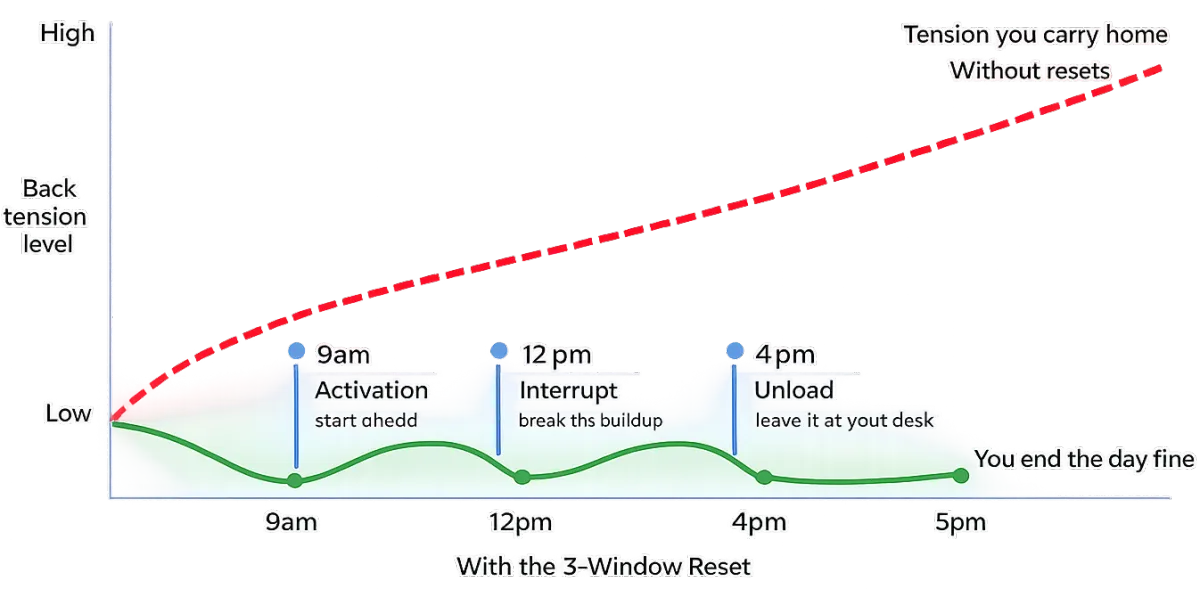
Your body follows a predictable compression pattern through a standard workday. Not gradually and evenly, but in phases tied to how long you have been sitting and how your nervous system is responding to accumulated load.

9am

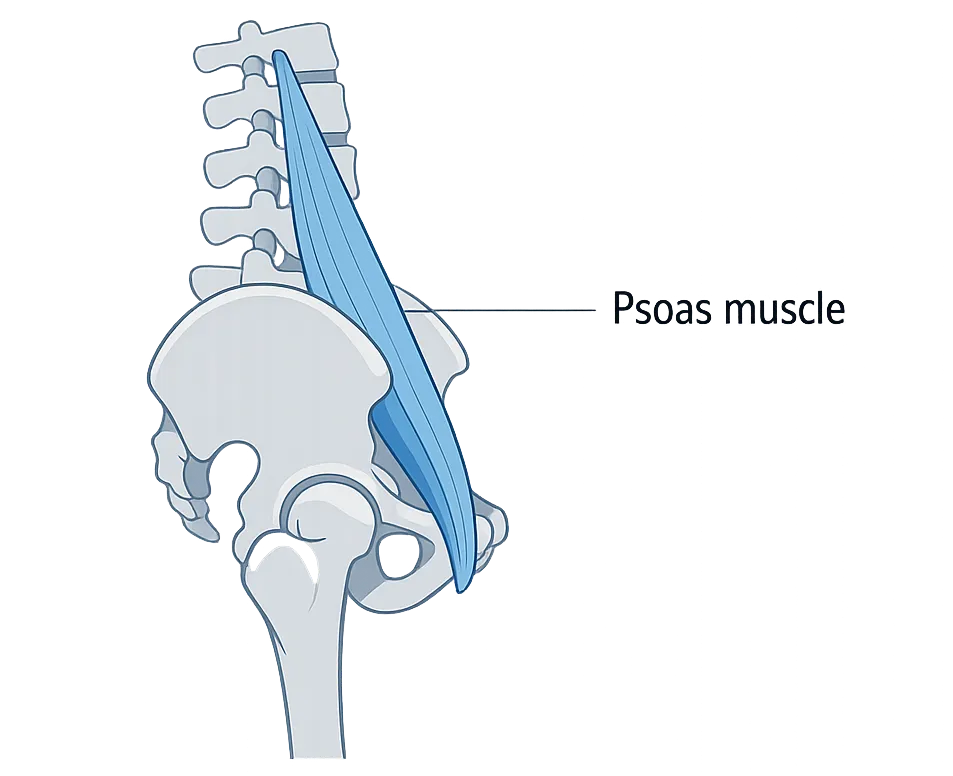
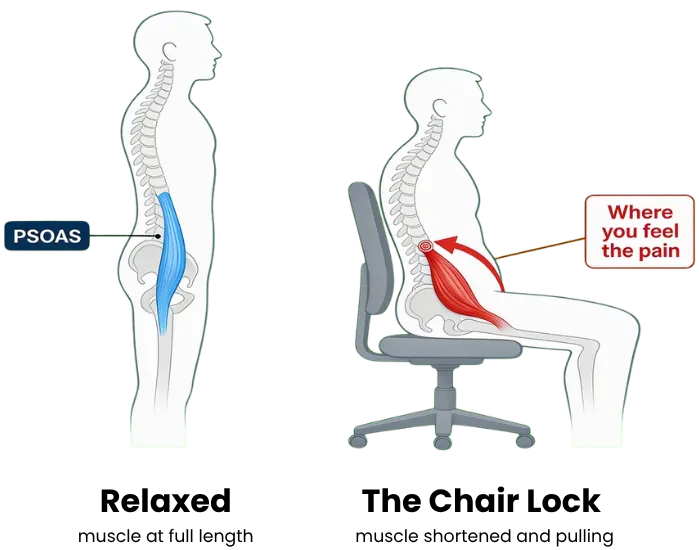
Hip flexors and spinal joints arrive stiff from overnight inactivity. Left unaddressed, this becomes the compressed baseline everything else builds on through the day.

Most Critical

12pm

Four hours of sitting have compounded. This is where tension either gets interrupted or starts locking in. Miss this window and the afternoon is already set against you.

4pm

Compounded afternoon load either gets released here or travels home with you. This window determines whether your evening belongs to you or to your back.

This is why end-of-day stretching gives temporary relief at best. The compression has already set. You are undoing in ten minutes what built across nine hours. Intervening at each window, before the tension locks, changes the pattern entirely.

The solution

Introducing The 3-Window Reset System

One insight drives the whole protocol. Compression relief works best when it is timed to your body's natural tension windows.

Tacking a stretch onto the end of the day, after the buildup has already set, is the wrong approach entirely.

9am

The Activation

Mobilises joints stiff from overnight, primes the posterior chain, and sets a decompressed baseline before the first hours of sitting load the spine.

Most Important

12pm

The Midday Interrupt

Breaks the compression cycle at its most critical point. Applied before four hours of accumulated load compounds into the afternoon tension most desk workers accept as unavoidable.

4pm

The Unload

Decompresses the posterior chain and signals the nervous system the workday's physical demands are over. The tension stays at the desk. You go home lighter.

All three sessions done from a standard office chair  ·  No mat  ·  No equipment  ·  3 minutes each

Session One · 9am

The Activation Reset: Start the Day Already Ahead of the Tension Curve

Most people arrive at their desk already carrying tension from an overnight spent in a static position. The 9am Activation takes three minutes to mobilise the hip flexors, decompress the lumbar spine, and prime the posterior chain before the first hours of sitting lock in a compressed baseline.

All you do is follow the card. The session runs on its own internal logic. You do not need to think about it, know anatomy, or remember what comes next.

Session Two · 12pm

The Midday Interrupt: The Most Important Three Minutes in Your Workday

A randomised controlled trial found that active break interventions cut pain recurrence from 44% down to 21% in high-risk desk workers, with recovery time cut in half. The midday window is where that intervention is most effective.

The Midday Interrupt resets the forward fold, spinal rotation, and knee drive. These are the three movements that directly counter the compressive pattern four hours of sitting creates in the lower back and hip complex. It only takes three minutes. It changes the entire second half of your day.

Session Three · 4pm

The 4pm Unload: Leave the Tension at Your Desk

The afternoon session targets the posterior chain, lateral spine, and breathing pattern. These are the three systems that accumulate the most load through the second half of a workday and are directly responsible for the tension most desk workers carry into their evenings.

Research found significant decreases in lower back, neck, and total spine discomfort among office workers who completed structured active breaks, with no adverse impact on productivity. The 4pm Unload is the final piece of that pattern.

What the Research Shows About Timed Movement Breaks

Industry research shows

65%

of desk workers develop musculoskeletal issues like back pain. This figure has remained largely unchanged despite decades of ergonomic product investment.

44 to 21%

Pain recurrence dropped from 44% in the control group to 21% among office workers who received structured active break interventions, in a 3-arm randomised controlled trial.

ScienceDirect / Applied Ergonomics

Significant

decreases in neck, lower back, and total spine discomfort were recorded in office workers who completed structured active movement breaks, with no adverse impact on work output.

Springer Nature Sports Sciences for Health, 2025

How This Was Built

Six Months in the Research Before We Wrote a Single Movement

The back pain industry is enormous. Ergonomic chairs, standing desks, posture correctors, lumbar supports. We looked at all of it. And we found one thing consistent across the clinical literature: the products people spend money on target static positioning, not the dynamic compression cycle that actually causes daily tension to accumulate.

We pulled peer-reviewed studies from industries research data, applied ergonomics research, and randomised controlled trials specifically on desk workers. The pattern that emerged from the data was clear. Workers who applied short structured movement breaks at timed intervals showed significantly lower pain recurrence and faster recovery than those who used any passive intervention or end-of-day stretching.

But the research protocols were clinical. Designed for study settings, not real workdays with back-to-back meetings and a full inbox. So we took the underlying timing principles and the most consistently effective movement patterns and built a system around them that a person could follow from their office chair without a second thought.

That system is The Desk Reset Protocol. Not a fitness product. Not a physiotherapy programme. A compression interruption protocol, built directly from the data that desk workers have never been given in a usable form. Until now, this level of structured timing existed only in clinical trials. You now have it in a single PDF.

What Happens When You Interrupt the Cycle

I had been managing lower back tightness for about two years. I tried a standing desk and a lumbar cushion and the tension always came back by mid-afternoon. I started the protocol on a Monday. By Thursday of the first week I noticed I was reaching the end of the day without that familiar pressure behind my lower back. By week two it was consistent.

Richard

Marketing Manager, 34

Desk job, 8 or more hours daily

The midday session is the one that changed things. I used to hit 2pm feeling like I had been compressed into the chair. Now I do three minutes at my desk and I genuinely feel reset. I did not think something that simple could make a real difference. It does.

Dominic

Software Developer, 41

Remote worker, home office

I had basically accepted that evenings would involve my back. That was just what desk work did. The 4pm session was the one that changed that specifically. I finish work now and there is nothing carrying over. I did not realise how much energy I was spending managing that feeling until it stopped.

Francis

Operations Director, 47

Office-based, 9-hour days

How It Works

Three Steps. Fourteen Days. No Disruption to Your Workday.

1

Download and open the protocol

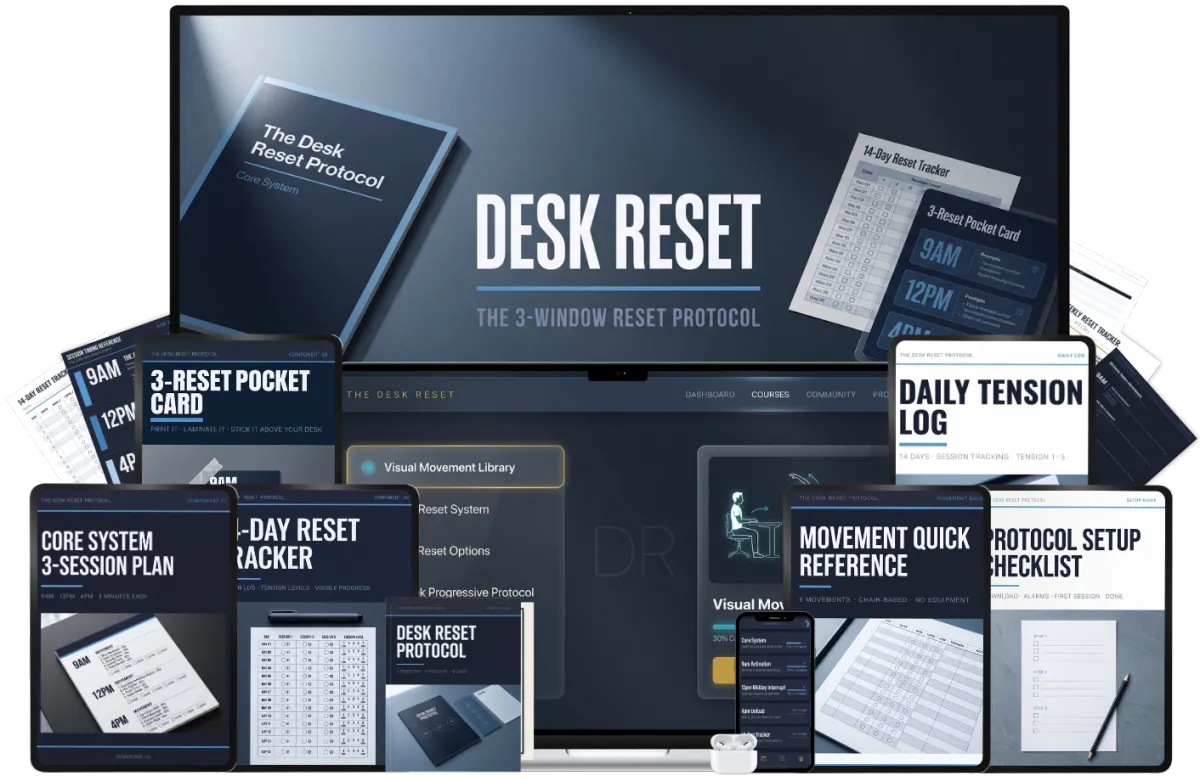
Instant access after checkout. The full system is in a single clear PDF: the 3-session protocol, the 14-Day Tracker, and the printable Pocket Card. Everything you need is in one file.

2

Set three alarms. Start today.

9am. 12pm. 4pm. Each session is 3 minutes. The Pocket Card lives above your desk. You follow, not think. There is nothing to memorise and nothing to figure out.

3

Track 14 days and feel the shift

The Tracker records your pain level and session completion each day. Most people notice a difference within the first week. By day 14, the pattern is set and the compression cycle is broken.

What's Inside

Everything You Receive Today

01

The Desk Reset Protocol: Core System

The full three-session daily plan — the 9am Activation, the 12pm Midday Interrupt, and the 4pm Unload — with every movement, timing cue, and form instruction laid out clearly so you complete each reset in three minutes without having to think about what comes next. Open it once, follow the card, and the system runs itself.

02

The 14-Day Reset Tracker

A daily log for session completion and afternoon tension levels. Shows you in writing exactly how the protocol is working across two weeks, so the progress is visible, not just felt.

03

The 3-Reset Pocket Card

Print it. Laminate it. Stick it above your desk. All three sessions on one card, so the next movement is always in front of you and never in your head.

Here is the thing about back tension: it does not stay still. Every day the compression cycle runs uninterrupted, your nervous system adapts a little further to the new baseline. What started as occasional afternoon tightness becomes the condition you manage rather than solve.

This is not inevitable. It is a pattern, and patterns can be interrupted. But the longer a pattern runs, the more embedded it becomes. The decision you make today determines whether you are still shifting in your seat at four o'clock next month, or whether that feeling is already behind you.

Thirty days from now, one of two things will be true. Either you will be thirty days older and carrying the same tension. Or you will be thirty days older and the pattern will be broken. The only difference is what you do in the next few minutes.

When You Get The Desk Reset Protocol Today, Here Is Everything You Receive

Complete Digital Bundle

The Desk Reset Protocol

  • The Desk Reset Protocol: Core Systemthe full 3-session daily plan with every movement and timing cue so you complete each reset in three minutes without thinking.

  • The 14-Day Reset Trackerdaily log of session completion and tension levels so you can see your progress in numbers, not just feel it.

  • The 3-Reset Pocket Card print it, laminate it, and stick it above your desk so the protocol is always visible and never memorised.

  • Instant digital downloadaccess everything within the next two minutes and start your first session today.

  • 30-day unconditional money-back guarantee complete risk removal. No questions, no conditions, no hassle.

A single physiotherapy consultation runs between $80 and $150 and lasts thirty minutes. It will not give you a system to use at your desk every day. The Desk Reset Protocol gives you the system, the tracker, and the reference card. You are not paying anything close to what that costs.

The Desk Reset Protocol: Core System.... $27

The 14-Day Reset Tracker ....................... $17

The 3-Reset Pocket Card......................... $9

Total value...................... $53

Usually $53

$14.95

One-time payment · No subscription · No recurring charges

Secure checkout · Instant delivery · 30-day money-back guarantee
You will be through your first session within minutes of downloading.

30
DAY
GUARANTEE

You do not have to say yes today. You only have to say maybe. Try The Desk Reset Protocol for 30 days. Go through the full 14-day protocol. If your back tension has not meaningfully reduced, contact us and we will refund every penny. No questions. No conditions. No hassle. The risk is entirely on us.

Common Questions:

"Isn't this just stretches I could find free on YouTube?"

You could find individual stretches for free, sure. What you won't find for free is the timing system — which movements, at which exact windows in your workday, and why those windows matter. That structure is the entire mechanism. Random stretching when you remember to is not the same as interrupting compression before it locks in

"I've tried things before and nothing stuck. How is this different?"

Most things people try (new chairs, lumbar cushions, standing desks) are static — they change your position, not your pattern. This is a 3-minute, three-times-a-day system with a tracker and a pocket card built specifically so you don't have to rely on memory or motivation. You follow the card. That's the whole job.

"What if I miss a session some days?"

Miss one, do the next one. The system is built around consistency over two weeks, not perfection on any single day. The tracker is there to show you the pattern, not to guilt you over a missed session.

"Do I need any equipment or a mat?"

No. Every session is done from a standard office chair. No mat, no resistance bands, no extra purchases.

"How fast will I notice a difference?"

Most people notice a change within the first week, with the pattern fully set by day 14. Everyone's different, which is exactly why there's a 30-day guarantee — if it's not working for you, you get your money back, no conditions.

"Is this a replacement for physical therapy or seeing a doctor?"

No. This is an educational wellness system, not a medical treatment. If you're dealing with severe or persistent pain, please see a healthcare professional. This is built for the everyday tension most desk workers experience, not for diagnosing or treating a medical condition..

"What exactly do I get after I buy?"

Three PDFs delivered instantly: the Core System (all three sessions), the 14-Day Tracker, and the printable Pocket Card. Everything is in your inbox within minutes of checkout.

You Have Three Options From Here

Option 1: Do Nothing

Close this page and continue as you are. The compression cycle runs tomorrow. And the day after. The tension becomes background noise you have stopped noticing except when it gets bad enough to notice.

Option 2: Figure It Out Yourself

Search for stretching routines, buy another accessory, watch another physio video. Spend time and money assembling something that probably will not account for the timing that makes all the difference.

RECOMMENDED

Option 3: Reset the Pattern

Get The Desk Reset Protocol for $14.95. Set three alarms. Start today. By this time next week you will know whether your back is changing. If it is not, ask for your money back. There is genuinely nothing to lose here.

The people who get through their workdays without back tension carrying into the evening are not in better shape than you, do not have better chairs than you, and are not more disciplined than you. They simply interrupted the pattern earlier. Now you know how to do the same.

Only you can decide.

Desk Reset Protocol

© 2026 Desk Reset Protocol · deskresetprotocol.com · All rights reserved. This product is a digital download for informational and educational purposes only. It is not intended to diagnose, treat, cure, or prevent any medical condition. If you are experiencing severe or persistent back pain, consult a qualified healthcare professional. Results may vary based on individual use and consistency.